What Shots Do You Need to Go to Africa? Guide
Travel to Africa requires specific vaccinations depending on your destination and health history. Yellow fever vaccination is mandatory for entry into many African countries, particularly in sub-Saharan regions. Routine vaccines—measles, polio, tetanus, and hepatitis A—should be current, while hepatitis B, typhoid, rabies, and meningitis are recommended based on your itinerary and activities.
South Africa, Botswana, and Namibia typically require only routine immunizations unless you're arriving from a yellow fever-endemic country. West and Central African nations enforce yellow fever certification at immigration. High-risk areas for malaria—including rural Mozambique, Zambia, and parts of Kenya—require antimalarial medication rather than vaccination.
Seek medical advice from a travel health clinic at least six to eight weeks before departure. The CDC and WHO maintain current vaccination requirements by country. Once your health preparations are complete, ensure reliable connectivity with an eSIM for Africa to access maps, booking confirmations, and emergency contacts throughout your trip.
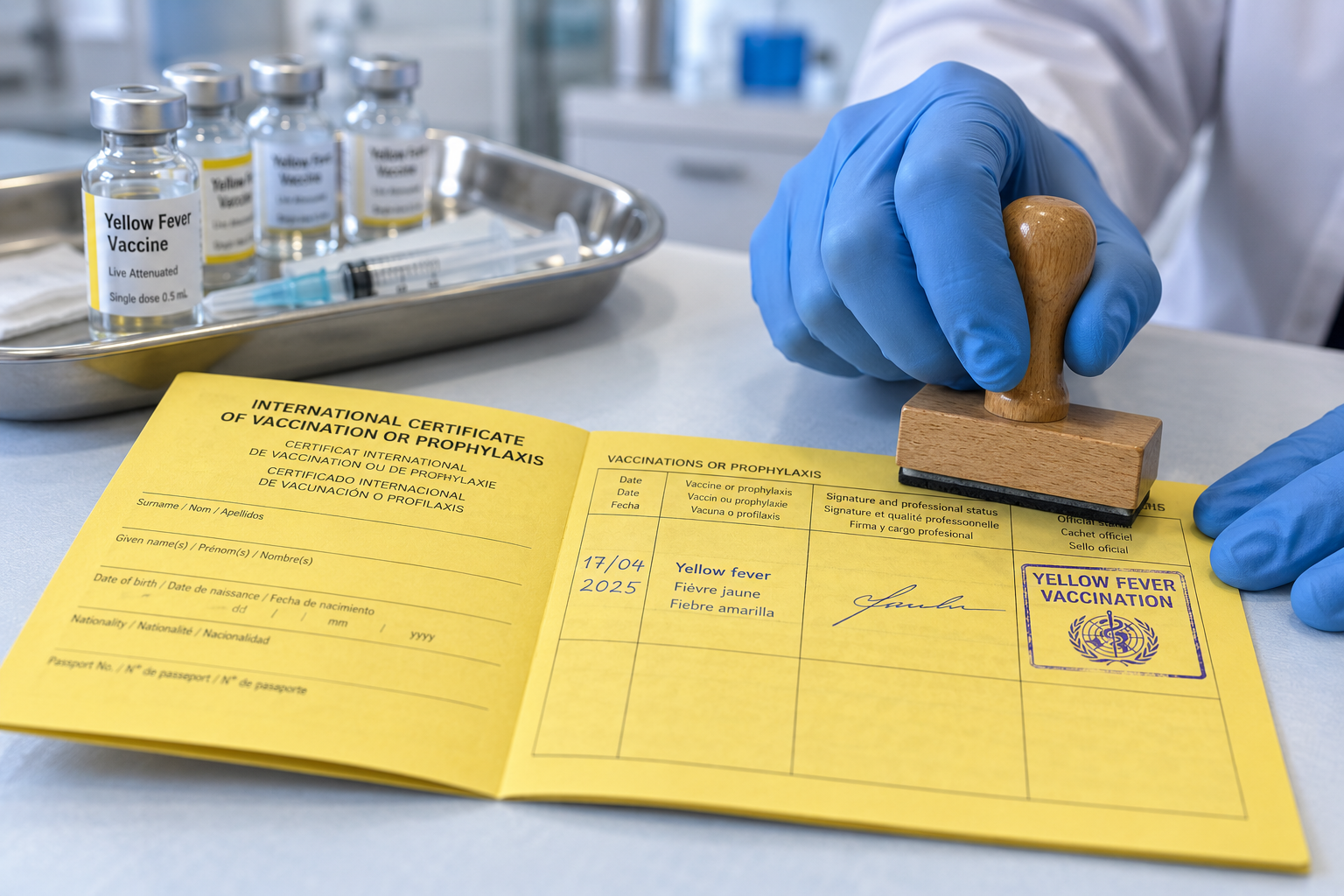
An International Certificate of Vaccination is required for entry into many African countries
Yellow fever vaccination stands as the only legally mandated immunisation for entry into many African countries, particularly those in endemic zones spanning from Senegal to Ethiopia and south through Angola. Travellers arriving from infected areas must present a valid International Certificate of Vaccination or Prophylaxis (ICVP) at border control. Kenya, Tanzania, and South Africa enforce this requirement strictly for arrivals from yellow fever regions.
Beyond legal requirements, the U.S. Centers for Disease Control and Prevention and World Health Organization recommend routine vaccinations remain current: measles-mumps-rubella (MMR), diphtheria-tetanus-pertussis, varicella, polio, and annual influenza. Hepatitis A vaccination is strongly advised for all African destinations due to potential exposure through contaminated food and water, while hepatitis B is recommended for those expecting close contact with local populations or requiring medical procedures.
Travellers heading to rural areas or planning extended stays should seek medical advice regarding typhoid, rabies, and meningococcal vaccines 4–6 weeks before departure to allow time for full immunisation courses.
Yellow fever vaccination is mandatory for entry into several African nations, and proof of immunisation must be presented at immigration. A valid International Certificate of Vaccination or Prophylaxis (ICVP) becomes effective 10 days after the jab and remains valid for life.
Countries requiring yellow fever vaccination include Angola, Benin, Burkina Faso, Burundi, Cameroon, Central African Republic, Congo, Côte d'Ivoire, Democratic Republic of the Congo, Gabon, Ghana, Guinea-Bissau, Kenya, Liberia, Mali, Mauritania, Niger, Rwanda, Sierra Leone, Togo, and Uganda. South Africa requires proof only if you're arriving from a yellow fever-endemic area within six days of travel.
The World Health Organization maintains an updated list of affected regions. Travellers should seek medical advice at least four to six weeks before departure, as the vaccine needs time to confer immunity. High-risk areas include rural regions where mosquito exposure is elevated.
Before you travel, sort your connectivity with an eSIM for East Africa to stay connected without the need for physical SIM cards at immigration.
Africa spans 54 countries with vastly different health risk profiles, so vaccination needs vary by region. East African countries including Kenya, Tanzania, and Uganda typically require yellow fever proof plus hepatitis A and typhoid. Southern destinations like South Africa and Botswana carry lower malaria risk in cities but higher rates in rural game reserves, making antimalarial medication essential for safari travel.
West Africa presents the highest yellow fever transmission risk, with Nigeria, Ghana, and Senegal enforcing strict vaccination documentation at entry. Meningococcal meningitis vaccine is strongly recommended for travel during the December-to-June dry season across the Sahel belt. Rabies vaccination should be considered for extended stays in rural areas or work involving animals.
North African countries including Egypt and Morocco generally require only routine vaccinations, though hepatitis A remains recommended. Before booking, check the CDC's country-specific pages and seek medical advice 6–8 weeks before departure. Once your health prep is sorted, secure reliable connectivity with the best eSIM for East Africa to access travel resources and emergency contacts on the ground.
Malaria poses a significant health risk across much of sub-Saharan Africa, transmitted by mosquitoes in rural and urban areas below 2,500 metres elevation. The CDC classifies most of East, West and Central Africa as high-transmission zones, where prophylaxis is strongly recommended for all travellers.
Three antimalarial tablets are widely prescribed: atovaquone-proguanil (Malarone), doxycycline, and mefloquine. Malarone is taken daily starting one to two days before travel and continuing seven days after departure. Doxycycline requires daily dosing from two days before until four weeks after exposure. Mefloquine is taken weekly, beginning two weeks prior. South Africa's Kruger National Park and northern KwaZulu-Natal carry moderate seasonal risk from September to May, while Cape Town and the Garden Route are malaria-free.
Start prophylaxis before departure as prescribed, and seek medical attention immediately if fever develops during or after your trip. Tablets do not replace insect repellent, long sleeves after dusk, and treated bed nets in endemic areas.
Hepatitis A and B: Why These Matter for Africa
Hepatitis A spreads through contaminated food and water—common risks across Africa where sanitation standards vary widely. The CDC reports infection rates in sub-Saharan Africa reach 8–10% of the population, making vaccination essential before travel. You'll need two doses six months apart for full protection, though a single shot offers coverage for your trip if time is short.
Hepatitis B transmits through blood and bodily fluids. Medical facilities in rural areas may reuse needles, and road accidents requiring emergency care are frequent—the WHO notes Africa has the highest traffic fatality rate globally. The three-dose series takes six months to complete, so start early. An accelerated schedule compresses this to three weeks plus a booster at 12 months.
Both vaccines are recommended for all African destinations by the CDC travel health portal. If you're planning extended stays or will be working in healthcare, seek medical advice about the combined Hepatitis A+B vaccine, which reduces the total number of injections needed.
Timing Your Vaccinations: How Far in Advance to Book
Most travellers underestimate how much lead time vaccinations require. Book your travel health appointment at least 6 to 8 weeks before departure to allow time for multi-dose schedules and immune response to develop fully.
Yellow fever vaccination takes 10 days to confer immunity and remains valid for life. Hepatitis A requires a single dose 2 weeks before travel, with a booster at 6 to 12 months for long-term protection. The hepatitis B series spans 6 months across three doses, though an accelerated 3-week schedule exists for last-minute travellers. Rabies pre-exposure prophylaxis demands three doses over 21 to 28 days.
Vaccine | Time before travel | Validity / Booster |
|---|---|---|
Yellow fever | 10 days | Valid for life |
Hepatitis A | 2 weeks | Booster after 6–12 months |
Typhoid | 2 weeks | Booster every 2–3 years |
Lead times for common travel vaccines
If you're pressed for time, clinics can still administer most vaccines up to 1 week before departure—partial protection beats none. The WHO International Travel and Health portal lists country-specific requirements, and the CDC's Travelers' Health site provides detailed vaccine schedules.
Once your medical prep is sorted, organise connectivity early too. An eSIM for East Africa ensures you can access health records, maps and emergency contacts the moment you land.
Kenya requires proof of yellow fever vaccination only if you're arriving from a country with risk of transmission. Travellers from WHO-listed endemic zones in South Africa, Ethiopia, or Uganda must present a valid certificate. Direct arrivals from Europe, North America, or Asia are exempt.
The Kenya Ministry of Health strongly recommends typhoid, hepatitis A, and routine boosters for tetanus and measles. Malaria prophylaxis is essential for coastal regions, including Mombasa and Malindi, and for safaris in Maasai Mara and Amboseli. High-altitude areas like Nairobi carry lower risk but seek medical advice if travelling between zones.
Rabies vaccination is recommended for extended stays in rural areas or wildlife zones. Polio proof may be requested at immigration if you've recently visited Pakistan, Afghanistan, or other endemic countries. Book your travel clinic appointment at least six weeks before departure to allow time for multi-dose vaccines. Staying connected with an eSIM for East Africa ensures you can access health resources and emergency contacts throughout your trip.
Even with vaccinations current, a well-stocked medical kit handles minor illness and injury when clinics are hours away. Pack prescription medications in original packaging with documented proof, especially antimalarials and any controlled substances that require customs clearance.
Include oral rehydration salts for traveller's diarrhoea—dehydration accelerates in high-altitude regions and tropical heat. Add a broad-spectrum antibiotic prescribed by your GP for bacterial gastroenteritis, antihistamines for allergic reactions, and a course of antimalarial standby treatment if you're visiting remote areas beyond regular prophylaxis coverage.
Wound care matters: sterile gauze, antiseptic wipes, blister plasters, and medical tape prevent infections in humid climates. Bring insect repellent with 30–50% DEET, a digital thermometer, and water purification tablets for off-grid travel. The WHO travel health guidance and CDC travellers' health portal list recommended supplies by region.
If you need emergency contact with South African or Kenyan medical providers, staying connected with a reliable eSIM for East Africa ensures you can seek help immediately.
Staying Connected: Why an eSIM Matters for Health Emergencies
Access to reliable mobile data can be critical when you need urgent medical assistance in Africa. An eSIM for East Africa activates the moment you land, giving you immediate access to maps, translation apps, and telehealth services without hunting for a physical SIM card or navigating unfamiliar mobile shops while unwell.
If you develop symptoms of malaria, typhoid, or a vaccine-preventable illness during your trip, fast communication with your travel insurance provider and local clinics can reduce time to treatment. Many African countries have robust mobile network operators, but coverage quality varies between urban centres and rural regions. Pre-loading an eSIM ensures you can reach emergency contacts, access the WHO's health advisories, and share your location with medical responders even in high-risk zones.
For travellers moving between Kenya, Tanzania, Uganda, and Rwanda, a regional eSIM eliminates roaming fees and keeps you reachable across borders—essential when your health depends on staying in touch.
How far in advance should I book my travel clinic appointment?
Schedule your appointment at least six to eight weeks before departure. Some vaccines require multiple doses spaced weeks apart, and your immune system needs time to build protection. Yellow fever certification becomes valid 10 days after injection.
Can I get vaccinated if I'm pregnant or immunocompromised?
Consult a travel medicine specialist immediately. Live vaccines like yellow fever are typically contraindicated during pregnancy, but your doctor may issue a medical waiver if travel to high-risk areas is unavoidable. Immunocompromised travellers need individualised protocols and may require additional prophylaxis.
Where can I find reliable health information for my destination?
The World Health Organization and CDC travel health notices publish country-specific vaccination requirements and disease outbreak alerts. South Africa's National Institute for Communicable Diseases offers regional updates. Staying connected with a reliable eSIM for East Africa ensures you can access medical resources and contact emergency services throughout your trip.

Kenya eSIM from $4.99 — Safari eSIM
Unlimited data on Safaricom. Built for safari travelers.
Get Safari eSIM