Mount Kenya Trekking Guide: Africa's Second-Highest Peak
Mount Kenya stands at 5,199 metres, making it Africa's second-highest mountain after Kilimanjaro. Three main routes lead to Point Lenana (4,985m), the trekker's summit: Sirimon from the northwest, Chogoria from the east, and Naro Moru from the west. Most climbers reach the summit in 4-5 days, with Sirimon-Chogoria being the most scenic combination.
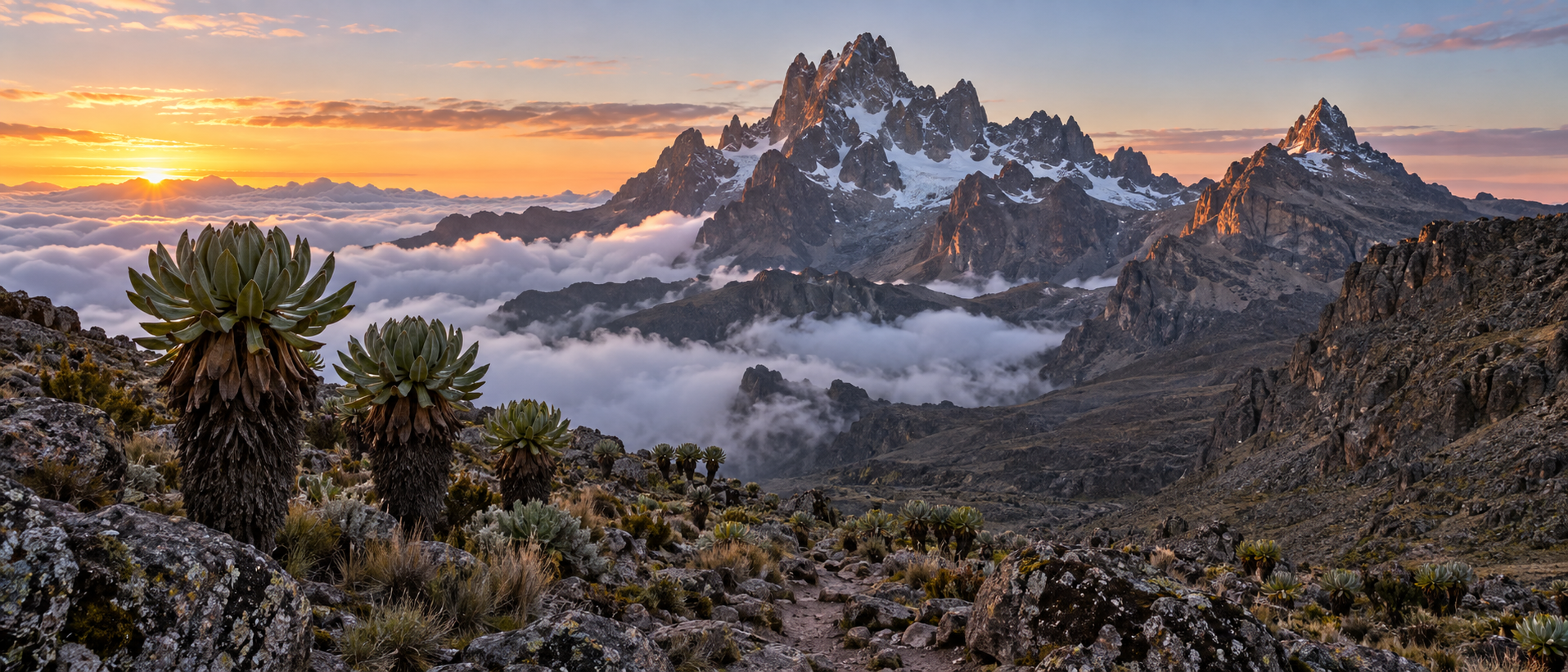
The mountain sits on the equator but features glaciers, alpine moorlands, and bamboo forests across its ecological zones. Technical climbing skills aren't required for Point Lenana, though you'll face altitude, early morning summit attempts around 3am, and temperatures dropping to -10°C. Batian (5,199m) and Nelion (5,188m), the true summits, demand rock climbing experience and proper equipment.
This guide covers route selection, acclimatisation schedules, gear requirements, permit costs, and what to expect at each camp from base to summit.
Mount Kenya Trekking at a Glance: Routes, Timing and Requirements
Mount Kenya offers three main trekking routes to Point Lenana (4,985m), the most accessible summit. The Sirimon route (5 days) ascends gradually from the northwest through forest and moorland, ideal for acclimatisation. The Chogoria route (6 days) approaches from the east through bamboo forest and high-altitude valleys, known for spectacular scenery including Lake Michaelson. The Naro Moru route (4 days) is the fastest but steepest, climbing 2,200 vertical metres in two days with minimal time for altitude adjustment. Each route features designated mountain camps at key elevations to help trekkers acclimatise safely.
Most trekkers target the dry seasons: January to February and July to October, which offer the best conditions for summit attempts. Night temperatures at altitude drop to -10°C year-round. Technical climbing to Batian (5,199m) and Nelion (5,188m) requires rock climbing experience, ropes and a qualified mountain guide. All visitors must enter through Kenya Wildlife Service gates, pay park fees (US$52 per day for non-residents), and trek with a registered guide—solo climbing is prohibited.
Do You Need a Guide to Climb Mount Kenya?
Yes. Kenya Wildlife Service regulations require all trekkers to hire a registered guide when climbing Mount Kenya. Solo attempts are not permitted, regardless of your mountaineering experience.
Your guide serves three essential functions beyond regulatory compliance. First, they navigate the unmarked sections common on Chogoria and less-traveled routes where cairns disappear under snow or fog. Second, they monitor altitude sickness symptoms and make descent decisions—critical above 4,200 meters where judgment deteriorates. Third, they coordinate logistics with park authorities and porters, particularly important for summit attempts on Point Lenana at 4,985 meters that require pre-dawn starts.
Guide costs typically range from $150 to $250 for a five-day trek, depending on route difficulty and group size. Sirimon and Naro Moru routes use the same guide pool, while Chogoria requires specialists familiar with its technical sections. Most reputable operators include the guide fee in package prices alongside park fees and accommodation, eliminating separate negotiations at trailheads.
Choosing Between the Sirimon, Chogoria and Naro Moru Routes
The Sirimon route ascends Mount Kenya's drier northwest side over 82 km return, typically taking four to five days. It offers gradual acclimatisation and ends at Point Lenana via a relatively gentle approach, making it the most popular choice for trekkers without technical climbing experience. The trail passes through moorland and alpine zones with excellent views of the northern glaciers.
Chogoria approaches from the east through bamboo forest and giant heather, delivering arguably the mountain's most scenic trekking. The 64 km route includes the dramatic Gorges Valley and Lake Michaelson before reaching Point Lenana. Most trekkers combine Chogoria for ascent with Sirimon for descent, creating a traverse that showcases the mountain's contrasting ecosystems.
Naro Moru is the shortest and steepest route at 60 km return. It climbs directly up the western side through the notorious Vertical Bog—a muddy stretch that can be challenging after rain. The route's directness means less time for acclimatisation, increasing altitude sickness risk, but experienced mountain trekkers often prefer its efficiency for a quick summit attempt.
How Long Does It Take to Hike Up Mount Kenya?
Most trekkers reach Point Lenana (4,985m) in 4–5 days, though faster 3-day ascents and more gradual 6-day itineraries exist. Your route choice dictates the timeline: Sirimon–Chogoria traverse typically takes 5 days, Sirimon up-and-down requires 4 days, and Naro Moru can be completed in 3–4 days but offers less acclimatisation time.
The standard schedule allocates 2–3 days for ascent with overnight stops at 3,300m and 4,200m, a pre-dawn summit push on day 3 or 4, and 1–2 days for descent. Experienced trekkers sometimes attempt Point Lenana in 3 days, but altitude sickness risk increases significantly without proper acclimatisation. Guides recommend an extra acclimatisation day at Shipton's Camp (4,200m) if you're flying directly into Nairobi rather than spending time at intermediate altitude beforehand.
Technical climbing routes to Batian (5,199m) and Nelion (5,188m) require 5–7 days minimum, with 2–3 days spent on rock and ice above Austrian Hut.
Point Lenana and Mount Kenya's Technical Peaks Explained
Mount Kenya has three main summits. Point Lenana sits at 4,985 metres and requires no technical climbing—most trekkers reach this peak via the Sirimon or Chogoria routes using scrambling skills only. Batian (5,199 metres) and Nelion (5,188 metres) are the true summits, both demanding rock climbing experience, ropes, and specialised mountain guides certified for technical ascents.
The altitude difference between Point Lenana and Batian is 214 metres, but the climbing difficulty jumps dramatically. Batian requires grade IV–V rock climbing over vertical sections, ice climbing on the Diamond Couloir or Gate of the Mists, and typically takes three to five days from the roadhead including acclimatisation. Only climbers with alpine experience attempt these peaks; they're not part of standard trekking packages.
When guides and tour operators mention "summiting Mount Kenya," they're referring to Point Lenana unless explicitly stated otherwise. If you want to climb Batian or Nelion, you'll need to arrange a technical mountaineering expedition separately, not a trekking guide.
Is Mount Kenya a Hard Climb? Difficulty, Fitness and Altitude
Mount Kenya is moderately difficult. Reaching Point Lenana at 4,985 metres requires no technical climbing skills, but the altitude and multi-day effort make it physically demanding. Most trekkers experience headaches, fatigue and shortness of breath above 4,000 metres, even when fit.
You need a base fitness level to walk 5–7 hours daily over rough terrain carrying a daypack. Regular hillwalking or running for three months before your trip is enough preparation for most people. The Sirimon and Chogoria routes involve long, steady ascents rather than steep scrambles, so stamina matters more than technical skill.
Altitude is the limiting factor. Your guide will set a slow pace—pole pole—to help your body adjust. Sleeping at intermediate camps (3,300 metres, then 4,200 metres) before the summit attempt reduces the risk of altitude sickness. Trekkers who rush the ascent or skip acclimatisation days are far more likely to turn back early.
The technical peaks—Batian (5,199 metres) and Nelion (5,188 metres)—require rock-climbing experience, ropes and a qualified mountain guide with alpine training.
How Much Does It Cost to Trek Mount Kenya?
Budget trekkers on the Sirimon or Naro Moru route spend KES 25,000–35,000 for three days, covering park fees (USD 52 per day for non-residents), basic hut accommodation (KES 2,000–3,000 per night), and a mandatory guide (KES 3,000–5,000 daily). The Chogoria route adds KES 5,000–8,000 for vehicle transfers from Chogoria village to the roadhead.
Organized treks through outfitters cost USD 600–900 for Sirimon or Naro Moru, and USD 800–1,200 for Chogoria, including guides, porters, meals, and camping or hut fees. Technical climbs to Batian or Nelion require certified mountain guides and specialist gear, pushing costs to USD 1,500–2,500.
Park fees are non-negotiable: USD 52 per person per day for non-residents, plus KES 300 for vehicles if driving to trailheads. Porters charge KES 2,500–4,000 daily and carry up to 18 kg, reducing the physical load on summit day. Most climbers budget an additional KES 5,000–10,000 for tips, gear rental, and evacuation insurance.
Best Seasons, Weather and Packing Checklist
Mount Kenya has two dry seasons ideal for trekking: January to February and July to October. Expect clearer skies, firmer trails and better summit visibility during these months. The wettest periods—April, May and November—bring muddy routes and cloud cover that can obscure Point Lenana entirely.
Temperatures vary drastically by altitude. At trailheads around 3,000 metres, daytime highs reach 15–20°C. Above 4,500 metres, nighttime temperatures drop to -10°C or lower, with strong winds on exposed ridges. The Chogoria route crosses open moorland where weather shifts rapidly; the Sirimon route offers slightly more shelter in its upper sections.
Pack in layers: moisture-wicking base layers, insulating fleece, waterproof jacket and trousers. Bring a four-season sleeping bag rated to -15°C, trekking poles for steep descents, high-energy snacks, sunscreen and a headlamp with spare batteries. Your guide will carry group equipment, but personal gear stays with you. If you need to check logistics or arrange transport before your climb, staying connected with reliable mobile data helps—an eSIM with unlimited data works across the mountain's lower zones and in nearby towns.
Altitude Acclimatisation, Safety and Responsible Trekking
Altitude sickness is the primary risk on Mount Kenya. Point Lenana sits at 4,985 metres, where oxygen levels drop to roughly 60% of sea level. Symptoms—headache, nausea, dizziness—typically appear above 3,500 metres. The golden rule: climb high, sleep low. Multi-day itineraries that include acclimatisation hikes before summit night reduce risk significantly.
Descend immediately if symptoms worsen despite rest. Guides carry pulse oximeters and monitor trekkers on Sirimon and Chogoria routes. Porters should not carry more than 18 kilograms excluding their own gear—verify weight limits with your operator. Leave no trace: carry out all rubbish, use designated toilet facilities at huts, and stay on marked trails to prevent erosion on fragile alpine moorland.
Mountain Rescue operates from the park gates. Mobile coverage on the mountain is patchy; Airtel Kenya and Safaricom offer the most reliable signal at lower camps. Register your trek with Kenya Wildlife Service and carry comprehensive travel insurance that covers evacuation above 4,000 metres.
Getting to Mount Kenya and Staying Connected with an eSIM
Most trekkers fly into Jomo Kenyatta International Airport in Nairobi, then drive three to four hours north to the mountain. The Sirimon Gate sits 15 km from Nanyuki town on the northwest side, while Chogoria Gate lies roughly 30 km from Chogoria village in the east. Shared matatus run from Nairobi to Nanyuki (around KES 500–800) and from there you can hire a taxi to the gate, though many organised treks include road transfers in their package.
Mobile signal reaches base camps on most routes but drops as you climb toward Point Lenana. An eSIM loaded before departure means you can share GPS coordinates with your guide service, check weather forecasts at Old Moses or Minto's Hut, and contact emergency services if needed. Safaricom and Airtel Kenya both offer coverage around the mountain's lower slopes, but data becomes patchy above 4,000 metres on any network.
Mount Kenya Trekking FAQs: Guides, Routes, Costs and Summit Plans
Can beginners climb Mount Kenya?
Yes. Point Lenana (4,985 m) requires no technical climbing skills and suits fit beginners who acclimatise properly. The Sirimon and Chogoria routes offer gradual altitude gain through forest zones and high camps, and a licensed guide will set a sustainable pace to help you adjust to elevation. Batian and Nelion demand rock-climbing experience, ropes and specialised gear.
Which route is easiest for first-time trekkers?
Sirimon is the gentlest ascent profile with well-graded trails and huts spaced for acclimatisation. Chogoria descends more steeply and Naro Moru climbs the Vertical Bog, making both harder on knees and lungs for inexperienced trekkers.
Do I need a guide or can I trek solo?
Kenya Wildlife Service regulations require all trekkers to hire a licensed mountain guide. Solo, unguided access to the mountain is not permitted. Guides navigate weather, enforce acclimatisation rest days and coordinate emergency evacuations if altitude sickness develops.
How much does a five-day Mount Kenya trek cost?
Budget operators charge around USD 600–800 per person for Sirimon or Chogoria routes with hut accommodation, park fees, guide, porter and meals. Mid-range outfitters offering better food and smaller groups cost USD 900–1,200. Prices rise for technical climbs of Batian or custom itineraries.
What fitness level do I need for Point Lenana?
You should comfortably hike six to eight hours daily with a daypack on uneven terrain. Train with weighted hill walks and build cardiovascular endurance for three months before departure. Altitude, not technical difficulty, is the limiting factor for most trekkers.
When is the best time to climb Mount Kenya?
January to February and July to October offer the driest weather and clearest summit views. March to June and November to December bring afternoon rain, cloud cover and slippery trails, though fewer trekkers and lower costs appeal to experienced climbers.
How do I stay connected on the mountain?
Mobile signal fades above 3,500 m on all routes. Download offline maps and trekking guides before departure. An eSIM with unlimited data lets you share location and weather updates from trailheads and lower camps without swapping physical SIM cards.

Kenya eSIM from $4.99 — Safari eSIM
Unlimited data on Safaricom. Built for safari travelers.
Get Safari eSIM