Kenya eSIM for Families: Plans or Shared Hotspot?
Some links may earn us a commission, at no extra cost to you. How we’re funded ↗
Kenya eSIM for Families: Separate Plans vs Shared Hotspot comes down to independence versus simplicity. Choose separate plans if family members may split up, navigate alone or need reliable data throughout the day. Use one eSIM with a shared hotspot if everyone stays together and mainly needs messaging, maps and light browsing.
Families can choose independent data access on each phone or share one phone’s connection as a hotspot.
For a family of four, separate plans mean four activations and four data balances, but nobody depends on one phone. A shared hotspot requires only one plan, though the host phone must remain nearby, charged and connected. Video, photo uploads and app updates will draw from the same allowance.
Before choosing, confirm that each handset supports eSIM and the required network bands. You can compare Kenya travel eSIM options, then decide based on device compatibility, daily movement and who needs data when the family separates.
For most families travelling together in Kenya, separate eSIM plans win on convenience. Each person keeps their own data, so one can navigate from Nairobi while another streams music or calls a driver without sharing a single connection. If a child wanders off at a mall or two adults split up—one to the Karen shops, one to the Giraffe Centre—everyone stays connected instead of waiting for the phone with the hotspot to come back in range.
A shared hotspot is cheaper when your group moves as a tight unit and has light data needs. One person buys a larger plan, then others connect to that phone. The trade-offs are real: the hotspot phone drains battery quickly, the group must stay within Wi-Fi range, and speeds drop with each extra device. For low-data days or a family of two, that saving can be worth it. For longer trips, flexible plans for each person usually feel less stressful. If you’re choosing mainly on price, our roaming versus eSIM cost comparison helps clarify where a shared hotspot actually saves money.
The best setup depends on whether family members will stay together. Separate eSIMs provide the most freedom: each person can use maps, messages and bookings on their own compatible phone. A shared hotspot can reduce the number of plans needed, but everyone depends on the host phone.
Option | Best for | Main drawback |
|---|---|---|
Separate eSIMs | Older children, adults and anyone taking separate day trips | Each device needs its own plan and setup |
Phone hotspot | Families travelling together with light to moderate data needs | Drains the host phone’s battery and stops working when the host leaves |
Pocket WiFi | Several devices used in the same vehicle or accommodation | Another device must be charged, carried and kept within range |
A practical compromise is to install separate eSIMs for adults, then let younger children connect through a parent’s hotspot. Before purchasing several plans, compare Safari eSIM and Nomad Kenya for coverage, validity and data allowances that match the family’s itinerary.
A separate eSIM is the practical choice whenever your family will not stay in the same place. If one adult takes a matatu across Nairobi for a meeting while the other stays with the kids, a shared hotspot cuts off internet for whoever walks away. With individual eSIMs, each phone keeps its own data connection, so you can still send M-PESA, check a map, or call a driver without depending on someone else’s phone.
Separate plans also protect battery life and avoid the short-range limits of a hotspot, which can drop when phones are in different rooms or vehicles. Kids with their own phones need their own eSIM if you want to reach them directly, and two adults who both take work calls at the same time should not share one connection. If your group mostly moves together, one hotspot may be enough; if anyone plans to split off, buy that person a separate plan. Start by comparing coverage and data amounts on Airalo Kenya so each family member gets the right allowance.
Can you share a mobile hotspot with a Kenya eSIM?
Yes, if the Kenya eSIM provider allows tethering. Enable Personal Hotspot or Wi-Fi Hotspot on the phone, set a secure password, and connect family devices over Wi-Fi. All connected devices use the eSIM’s data allowance, so monitor streaming and downloads. The hotspot phone must stay nearby, powered on, and sufficiently charged while others are connected.
Can you share a hotspot with an eSIM?
Yes. A mobile eSIM can usually provide a mobile hotspot just like a physical SIM: switch on Personal Hotspot or Wi-Fi Hotspot, then connect another phone, tablet or laptop using the password shown. However, tethering must be permitted by the eSIM plan, so check the provider’s terms before buying. Some plans limit or block hotspot use even when ordinary mobile data works.
A shared hotspot is practical when family members mostly stay together. For example, one parent’s phone can connect two children’s tablets during a road trip or provide internet for a partner’s phone at the hotel. All connected devices draw from the same data allowance, and streaming or automatic photo backups can use it quickly. The host phone also needs to remain nearby, switched on and charged.
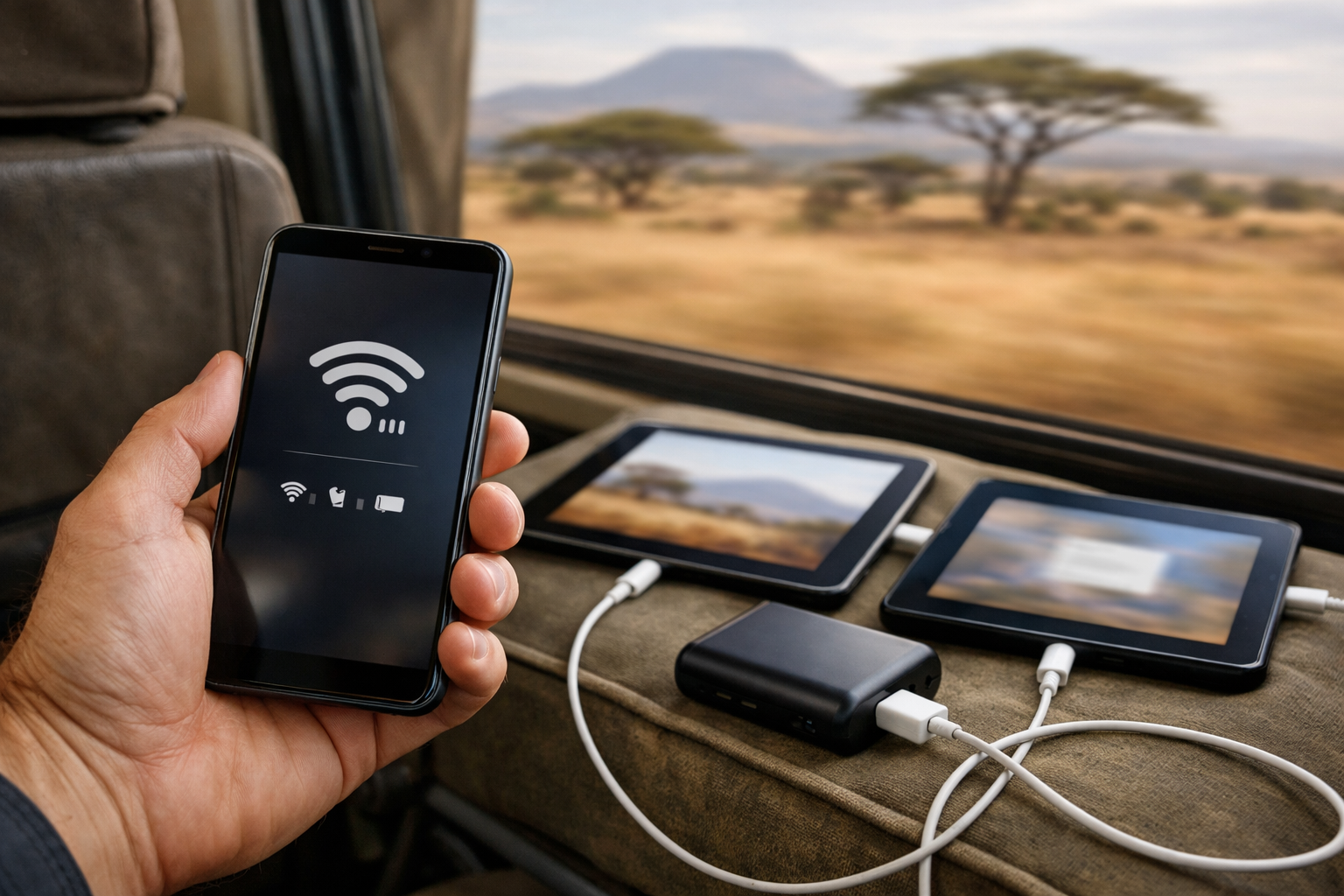
A shared hotspot works best when family members stay close to the host phone.
Confirm that the chosen Kenya eSIM plan permits hotspot use, and account for the host phone’s battery demands. Keep a charging cable or power bank handy, set a strong hotspot password and disable automatic app updates on connected devices. If family members will split up for sightseeing, separate plans are more dependable than one shared hotspot.
Are Kenya eSIM plans data-only, and how can families make calls?
Many Kenya travel eSIMs are data-only, so they do not include a Kenyan number, SMS or standard voice minutes. Families can make calls through WhatsApp, FaceTime, Signal or similar internet apps, provided everyone has data. Alternatively, keep a home SIM active for calls and texts, use the Kenya eSIM for data, or share one phone’s hotspot. Check roaming charges and plan terms before relying on the home line.
Are eSIM plans only for data?
No. However, many travel eSIM plans for Kenya are data-only, meaning they provide mobile internet but no Kenyan phone number, SMS allowance or standard voice minutes. Check the plan description before buying: some regional or operator-issued plans may include calls and texts. The differences between a Kenya eSIM and a physical SIM card also matter if receiving ordinary calls is essential.
With a data-only eSIM, family members can call through WhatsApp, FaceTime, Signal or another internet calling app. Everyone needs data access, either from a separate plan or through the host phone’s hotspot. App-to-app calls generally require both people to use the same service, while some apps also support calls to ordinary numbers.
Another option is dual-SIM use: keep the home SIM active for calls and SMS while using the Kenya eSIM for data. Confirm roaming charges before answering or making calls on the home line. If only one phone has data, agree on meeting points and backup contact arrangements because anyone leaving the hotspot’s range will lose internet calling and messaging.
Does eSIM work across Kenya on iPhone and Android devices?
Yes, an eSIM can work across Kenya on compatible iPhone and Android devices, provided the phone is unlocked and the plan supports Kenyan networks. Coverage depends on the underlying network, so service may vary between cities, rural areas, highways and national parks. Check each family member’s exact model and regional version before purchase, because Android eSIM support differs more widely than iPhone support. GSMA’s eSIM information provides an overview of how eSIM technology works.
Does eSIM work in Kenya?
Yes. An eSIM works in Kenya when the phone supports eSIM, is network-unlocked and the selected plan includes Kenyan coverage. It can connect in Nairobi, Mombasa and other covered areas, but an eSIM does not improve the underlying mobile network. Signal quality may vary on remote roads, inside national parks and in rural areas, just as it does with a physical SIM.
Recent iPhones commonly support eSIM, although availability can depend on the model and its country of purchase. On an iPhone, check Settings > Mobile Service > Add eSIM; see Apple’s eSIM travel guidance for compatibility and setup details. Android support varies more widely between manufacturers and even between regional versions of the same phone. Look under Settings > Network & Internet or Connections > SIM manager for an option to add an eSIM. You can also dial *#06#; an EID usually indicates eSIM capability. Google’s Pixel eSIM help explains where to find eSIM settings on supported devices.
Check every family member’s exact phone model rather than assuming all devices are compatible. If one person has an unsupported or locked phone, another compatible device can provide temporary internet through hotspot sharing. Before choosing a Kenya eSIM, confirm device compatibility, network coverage and whether the plan permits tethering.
How much family data will you need, and what will it cost?
Start with a daily allowance for each person, then multiply it by the trip length. For example, a family of four budgeting 500 MB per person per day would need about 2 GB daily, or 14 GB for one week. Messaging, email and occasional maps require less data than video calls, streaming, cloud backups or uploading holiday photos. Check each phone’s recent mobile-data usage for a more realistic estimate.
For separate plans, calculate the combined price of four suitable packages rather than comparing it with the headline price of a single eSIM. Review each plan’s data allowance, validity period, top-up options and whether unused data expires. Compare suitable plans against the family’s itinerary and expected usage before buying.
A shared hotspot may reduce the family’s total connectivity cost because only one plan is required. However, choose enough data for everyone and leave a buffer for heavy-use days. If the four-person family above expects 14 GB, a plan capped below that amount could mean buying a top-up or going without reliable access near the end of the trip. Separate plans may cost more overall, but each person can monitor and control their own allowance.
For separate plans, install and activate each eSIM on its intended phone while reliable WiFi is available. Label the new line “Kenya eSIM”, select it for mobile data and follow the provider’s data-roaming instructions. Turn off mobile-data switching so the phone does not fall back to the home SIM and trigger roaming charges. Choose each plan according to the trip length and that family member’s expected usage.
For a shared hotspot, use the phone with the healthiest battery as the host device. Set a strong password, connect family devices one at a time and remove any unfamiliar connections. Keep the host phone near the centre of the group rather than inside a packed bag, where heat and obstructions can weaken the connection.
To limit battery drain, lower the host phone’s screen brightness, close navigation or video apps when they are not needed, and carry a charged power bank. Pause automatic photo backups, app updates and large downloads on every connected device. If the hotspot becomes unstable, disconnect unused devices, toggle the hotspot off and on, then restart the host phone if necessary.
Are free eSIM trials with unlimited data and hotspot access genuinely useful?
A free eSIM trial can be useful for checking activation, signal and hotspot compatibility before relying on a plan for the whole family. Test it on the phone that will provide the single hotspot, then connect another phone or tablet and load maps, messages and a short video. This reveals whether the eSIM hotspot works properly and whether the connection remains practical when several devices share it.
Read the conditions carefully. “Unlimited data” may still involve reduced speeds after heavy use, while tethering may be capped or excluded altogether. A short trial can also expire before your trip if its validity starts when you install the eSIM rather than when you first connect in Kenya. Check the activation trigger, trial duration, hotspot policy, speed restrictions and whether a paid plan renews automatically.
For families, treat a trial as a technical test rather than the main travel plan. It cannot prove that one phone will support several users throughout long drives or full sightseeing days. After testing activation and hotspot access, choose either separate data plans for greater independence or one larger allowance for hotspot sharing.
How trip length, safari routes and Great Migration travel affect your choice
For a short trip based mainly in Nairobi, Mombasa or one resort, a shared hotspot can be practical if the family stays together. On a 10- to 14-day safari, separate plans become more useful because travellers may split between vehicles, rooms or activities, leaving some people without access to the hotspot phone. Compare suitable plans by validity period, data allowance and coverage rather than choosing solely by headline price.
Your route matters as much as trip length. Travel between Nairobi, Amboseli, Tsavo, Samburu and the Maasai Mara includes long road sections where signal quality can vary. If the hotspot phone loses service or runs out of power, everyone connected to it goes offline. Separate eSIMs give each adult or older child a better chance of sending messages, accessing bookings or contacting a driver independently.
Great Migration family travel may also involve remote camps or crossing into Tanzania. Confirm that the plan covers every country on the itinerary; a Kenya-only eSIM will not automatically provide travel connectivity after the border. For a cross-border trip, use regional plans or arrange separate country plans before departure.
How much is pocket WiFi in Kenya per month?
There is no single monthly price. The total depends on whether you rent or buy the router, the included data allowance, network, delivery location, deposit and rental period. “Per month” may mean a fixed 30-day bundle rather than a rolling contract. Before booking, request the complete cost of the device, data, delivery and any late-return charges, then compare that total with current roaming and eSIM costs in Kenya.
Can one Kenya eSIM serve the whole family?
Yes, if the plan allows hotspot use. One phone can share its connection with several family devices, but everyone loses access when that phone is switched off, charging elsewhere or out of range. A four-person family may therefore prefer separate plans when adults and teenagers often split up.
Can one phone hold multiple eSIMs?
Many newer phones can store multiple eSIMs, although the number that can remain active at once varies by model. Check the manufacturer’s specifications and confirm that the handset is unlocked before travel.
For independence, choose separate eSIMs. For a group staying together, a shared hotspot or pocket WiFi can be simpler.