Kenya Travel Warnings: What Visitors Need to Know
Kenya travel warnings issued by foreign governments focus on regional security risks, particularly near the Somalia and South Sudan borders, alongside urban crime in Nairobi and Mombasa. The U.S. State Department maintains a Level 2 advisory for Kenya as of October 2024, urging increased caution due to terrorism threats and crime, while the UK Foreign Office advises against all travel within 60 kilometres of the Kenya-Somalia border and specific northern counties including Mandera, Garissa, and parts of Lajikipia.
Most travel advisories distinguish between high-risk border zones and the country's main tourism circuits. Nairobi, the Maasai Mara, coastal resorts, and national parks remain accessible to international visitors, though petty theft and vehicle break-ins require standard urban precautions. Travellers should review Kenya visa entry requirements before departure and consider reliable connectivity options such as an eSIM for Kenya and Tanzania to stay informed during their trip.
Regional variations matter: while the coastal strip and central highlands see millions of tourists annually without incident, the northeastern counties bordering Somalia face ongoing security operations. Understanding these distinctions helps travellers plan routes that balance adventure with informed risk management.
Is Kenya Safe to Travel to Right Now?
Kenya remains open to international visitors in 2026, though the United States maintains a Level 2 advisory—Exercise Increased Caution—citing crime, terrorism, civil unrest, and kidnapping risks. The advisory was last updated in July 2026 with no change to the overall level. Most tourist destinations, including Nairobi, the Maasai Mara, and coastal regions, continue to welcome travelers, but specific border counties near Somalia face Level 4 (Do Not Travel) warnings due to terrorist activity and armed conflict.
Is Kenya safe to travel right now?
Yes, with proper precautions. Kenya receives over two million visitors annually, the majority of whom travel without incident, particularly in well-established safari circuits and national park areas. Violent crime—including armed carjacking, mugging, and home invasion—does occur, especially in urban centers and after dark. The homicide rate stood at 4.87 per 100,000 people in 2022, according to World Bank data. The U.S. State Department and UK Foreign Office both provide updated country-specific guidance on regional risk levels. Travelers should avoid border regions with Somalia, limit night travel, and stay informed through resources like the Kenya visa entry requirements guide, which covers documentation and current entry protocols for secure planning.
Nairobi and major cities: Exercise caution in crowded areas; avoid walking after dark
Safari parks: Generally safe with organized tours and licensed guides
Coastal areas: Lamu Island accessible; mainland Lamu County restricted
Northern border counties: Mandera, Wajir, Garissa under Do Not Travel advisories
What Do Current Official Travel Advisories Say About Kenya?
The United States maintains a Level 2 advisory for Kenya, recommending increased caution due to crime, terrorism, kidnapping, civil unrest, and traffic safety concerns. The UK Foreign Office similarly advises against all but essential travel to specific border regions. Canada requests a high degree of caution nationwide, with warnings against all travel to certain counties near the Somali border. Most major tourism destinations including Nairobi, Mombasa, and the Maasai Mara fall under the standard exercise caution class rather than higher-risk categories.
Where Not to Travel at the Moment?
Multiple governments advise against travel to the counties of Garissa, Wajir, Mandera, and most of Lamu County along the Somali border, citing elevated risks of terrorism and kidnapping. The US Department of State includes Tana River County (excluding Tsavo National Park), northern Kilifi County above highway C103, and coastal areas north of Malindi in its Do Not Travel level. The UK adds a 15-kilometre zone along the east coast between the Tana and Galana rivers. Lamu Island and Manda Island remain accessible by air only, with authorities warning against overland routes through surrounding areas.
Which Parts of Kenya Should Travellers Avoid?
Most foreign governments advise against travel to counties along the Kenya-Somalia border—specifically Mandera, Wajir, and Garissa—due to terrorism and kidnapping risks linked to armed groups operating across the frontier. Lamu County is also restricted, though Lamu Island and Manda Island remain accessible. The US and UK governments extend warnings to Tana River County north of the Tana River itself, parts of Kilifi County north of highway C103, and coastal areas north of Malindi, where criminal gangs and militia activity pose threats.
Western Turkana County and parts of West Pokot face advisories related to cattle rustling and banditry, which occasionally escalate into armed clashes between communities. Travellers exploring cross-border routes into Kenya and Tanzania should stay on major highways and avoid border zones entirely. Most medical and private security resources concentrate in Nairobi and coastal resort areas, leaving frontier regions with limited emergency response capacity. The country's national parks and established tourism circuits—including the Maasai Mara, Amboseli, and Tsavo East—fall outside restricted zones and operate under normal conditions.
What Do the Latest KNBS, NTSA, WHO and UN Safety Statistics Show?
The Kenya National Bureau of Statistics reported a population of 54.2 million in mid-2026, with inflation running at 6.8% in September. Road safety remains a critical concern: the National Transport and Safety Authority recorded over 2,000 fatalities in the first half of 2026 alone, with pedestrians accounting for 836 deaths. NTSA data shows Kenya experiences between 4,000 and 5,000 road deaths annually, with Friday through Sunday identified as the most dangerous days. More than 270 accident black spots have been mapped across the country, and the fatality rate stands at approximately 64 per 10,000 vehicles.
WHO situation reports tracked disease outbreaks through mid-2026, including 221 cases across 20 counties by week 28. Health infrastructure varies significantly by region, with major city centres offering better access to care than rural areas. The UN continues to classify most of Kenya at Phase 1 of its security plan, though northern districts including Turkana and Marsabit remain at Phase 3. For travellers moving between Kenya and Tanzania, road conditions and driver behaviour present greater day-to-day risks than health threats in most tourist areas. Countries across East Africa face similar traffic safety challenges, but Kenya's reporting systems provide more granular data than many neighbouring nations.
What are the main risks from crime, terrorism and demonstrations?
Terrorism remains the most serious security threat for visitors to Kenya. Al-Shabaab, the Somalia-based militant group, has carried out regular attacks in 2026, including a July ambush in Mandera that killed five security officers and a January incident in Garissa County that killed a local chief and a teacher. The UK Foreign Office states that terrorists are "very likely" to try to carry out attacks, with hotels, shopping centres, and transport hubs identified as potential targets. Most incidents occur in northeastern counties near the Somalia border, but Al-Shabaab has previously struck Nairobi, including the 2019 DusitD2 complex attack that killed 22 civilians.

Police presence at a public demonstration in Kenya — Photo: Fibonacci Blue / Openverse (CC BY)
Violent crime affects both urban centres and popular tourism areas, with Kenya's homicide rate recorded at 4.87 per 100,000 people in 2022. Carjackings, armed robberies, and muggings occur frequently in Nairobi and Mombasa, particularly after dark. Demonstrations over economic issues have turned violent in 2026, with at least four people killed and over 30 injured during May protests against rising fuel prices. Opposition political gatherings have also been targeted by unidentified armed groups in the lead-up to elections, reportedly killing at least six people across multiple incidents.
Kenya does not require yellow fever vaccination for travellers arriving directly from countries where the disease is not endemic, including the United States, Canada, most European nations, and Australia. However, if you're arriving from or have transited through a country where yellow fever is present—such as Uganda, Ethiopia, Tanzania, or South Sudan—you must present a valid yellow fever certificate upon entry. The Kenya Ministry of Health enforces this strictly at all ports of entry, and travellers without proof of vaccination from at-risk countries may be quarantined or denied entry.
Do I need yellow fever vaccine for Nairobi?
For Nairobi specifically, you do not need the yellow fever vaccine unless you fall under the transit rule above. The city sits at 1,795 metres elevation, well above the altitude where yellow fever-carrying mosquitoes thrive. Kenya's yellow fever risk zones are limited to areas below 2,300 metres in Western Kenya (counties near Lake Victoria including Kisumu and Busia) and parts of the Rift Valley. If your itinerary includes these regions, the CDC and WHO both recommend vaccination even though Kenya doesn't mandate it for domestic travel. Before planning any cross-border trips or multi-country itineraries in East Africa, review current Kenya visa entry requirements to ensure full compliance with health documentation.
What are Kenya's Current Entry Requirements for International Travellers?
Most international travellers must obtain an approved Electronic Travel Authorisation (eTA) before travelling to Kenya. You should also carry a passport valid for at least six months after arrival, with sufficient blank pages, and any required health certificates, such as yellow fever vaccination proof when applicable. Check official Kenyan guidance before departure, as requirements can change.
What are the entry requirements for travel to Kenya?
All international visitors to Kenya, including infants, must obtain an Electronic Travel Authorization (eTA) before departure. The eTA replaced the previous visa system in January 2024 and costs $30 USD, with processing typically completed within 24 to 72 hours. Applications are submitted entirely online through the official government portal at etakenya.go.ke. Airlines verify eTA approval before boarding, so travellers cannot arrive without this authorization.
Passports must remain valid for at least six months beyond your planned entry date and contain a minimum of two blank pages. Citizens of East African Partner States—Burundi, Democratic Republic of Congo, Rwanda, South Sudan, Tanzania, and Uganda—are exempt from the eTA requirement for stays up to 180 days. The UK Foreign Office recommends applying at least two weeks before departure to avoid any last-minute complications. Beyond the eTA, travellers should review Kenya visa entry requirements for information on specific documentation needed at immigration, particularly if arriving from a yellow fever-endemic country where additional vaccination proof may be requested despite not being a universal entry requirement for all visitors.
How Safe Are Nairobi, Mombasa, the Masai Mara and Other Popular Destinations?
Most major tourist destinations in Kenya present different risk profiles. Nairobi carries a medium-to-high crime risk, with armed robbery and carjacking reported regularly, though tourists staying in established neighbourhoods like Westlands, Karen and the central business district face lower exposure than government security assessments suggest. Mombasa ranks among Kenya's safer cities according to the National Crime Research Center, with petty theft and opportunistic crime more common than violent incidents in tourist zones along the north and south coasts.
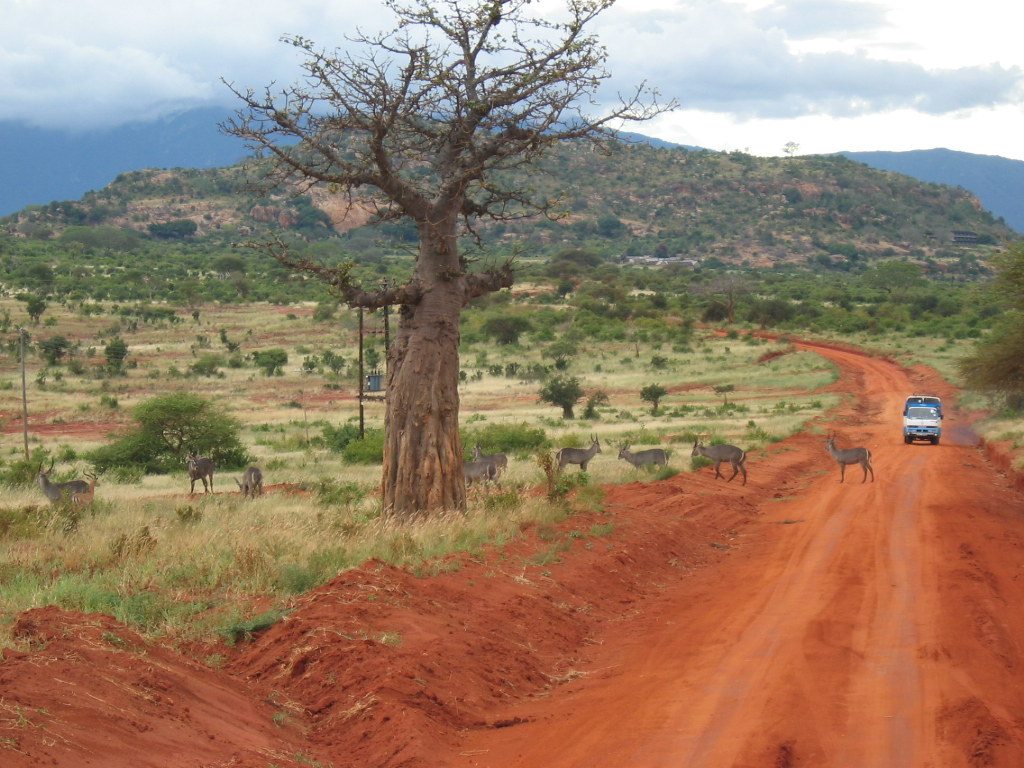
Safari vehicle on a Kenyan savanna — Photo: Adorenomis / Openverse (CC BY)
The Masai Mara remains one of the country's safest destinations for international visitors. The reserve recorded approximately 420,100 visitors in 2023, with no significant safety incidents reported in media coverage or official park communications. Wildlife-related risks are managed through strict regulations—only licensed tour operators with certified driver-guides are permitted inside the reserve, and all visitors must remain in vehicles except at designated points. Coastal areas near the Somali border and northeastern counties continue to require heightened caution, but the safari circuit encompassing Amboseli, Tsavo, Lake Nakuru and the Kenya and Tanzania eSIM coverage zones sees consistent tourist traffic with standard precautions sufficient for most travellers.
Kenya operates on East Africa Time (EAT, UTC+3) year-round with no daylight saving changes. Most international arrivals land at Jomo Kenyatta International Airport in Nairobi or Moi International Airport in Mombasa; domestic flights connect major parks and coastal towns through Wilson Airport and regional hubs. The National Transport and Safety Authority (NTSA) recorded 4,690 road fatalities in 2023, with the majority occurring on rural highways and at night. Use registered taxis, ride-hailing apps in cities, or pre-arranged transfers through lodges. Avoid matatus (shared minibuses) on intercity routes due to inconsistent safety standards.
Comprehensive travel insurance covering medical evacuation is essential—air ambulance repatriation from remote parks to Nairobi can exceed USD 50,000. Policies should include coverage for trip cancellation due to civil unrest and stolen belongings, as street theft remains common in urban centres. Store emergency numbers in your phone before departure: national police 999 or 112, Tourist Police Unit +254 20 604767, and your embassy's 24-hour line. The Aga Khan Hospital Nairobi (+254 20 366 2000) and Mombasa Hospital (+254 41 231 2191) provide reliable private care. Register with your embassy's traveller programme to receive real-time security alerts during your stay.
Frequently Asked Questions
Do I need a visa to enter Kenya?
Most visitors require a visa. Citizens of EAC member states enter visa-free; others apply for an eTA online before departure. Processing takes three to seven working days. Full details on eligibility, fees and application steps are covered in our Kenya visa entry requirements guide.
Is tap water safe to drink in Kenya?
No. Municipal water in Nairobi and Mombasa is treated but distribution networks are often compromised. Stick to bottled or filtered water throughout your stay. Hotels and lodges typically provide safe drinking water; ask reception if you're unsure about the source.
What vaccinations are compulsory for Kenya travel?
Yellow fever vaccination is mandatory if you're arriving from or transiting through a country with yellow fever transmission risk. Proof of vaccination must be presented at immigration. Routine vaccinations—hepatitis A, typhoid, tetanus—are recommended but not required for entry.
Can I use my phone normally in Kenya?
Yes, provided your device is unlocked. Local SIM cards and eSIM plans work on 4G networks nationwide, with 5G available in Nairobi and select urban centres. Coverage is reliable in cities and most national parks.

Kenya eSIM from $4.99 — Safari eSIM
Unlimited data on Safaricom. Built for safari travelers.
Get Safari eSIM