Safaricom vs Airtel in Kenya: Which Network is Best for Tourists?
Kenya has two main mobile networks: Safaricom and Airtel. For safari tourists, choosing the right network is one of the most important eSIM decisions you'll make.
Kenya's telecommunications landscape in 2026 is dominated by two major mobile network operators: Safaricom and Airtel. Both carriers provide robust 4G connectivity throughout major urban centers including Nairobi, Mombasa, and Kisumu, but their network performance and coverage capabilities differ substantially when you venture beyond city limits into rural areas, coastal regions, and wildlife conservation zones. For international travelers planning safari adventures, business trips, or extended stays in Kenya, selecting the appropriate mobile network represents one of the most critical eSIM decisions you'll make before departure. Your choice directly impacts your ability to stay connected, share experiences, access navigation services, and maintain communication with tour operators and accommodation providers throughout your journey across Kenya's diverse landscapes.

Mobile coverage can vary significantly between Kenya’s cities, highways and remote safari areas.
Safaricom — Kenya's Market-Leading Network Infrastructure in 2026
Safaricom maintains its position as Kenya's dominant telecommunications provider in 2026, controlling approximately 65% of the country's mobile market share and operating the most comprehensive 4G network infrastructure across both urban and rural territories. The carrier has invested heavily in expanding its coverage footprint to include remote regions, wildlife reserves, and national parks where competing networks often fail to reach. Safaricom's strategic tower placement prioritizes areas where Kenyan citizens actually live and work, which means you'll find reliable connectivity near safari lodges, national park entrance gates, conservation area headquarters, and rural settlements throughout the country. In metropolitan Nairobi, Safaricom subscribers typically experience average 4G download speeds ranging from 20 to 40 Mbps, providing sufficient bandwidth for video calls, social media uploads, and cloud-based applications. Within national parks and safari zones, speeds naturally decrease to approximately 5 to 15 Mbps where coverage exists, but this still supports essential communications, messaging applications, navigation services, and photo sharing for most travelers. Safaricom's network reliability and extensive rural coverage make it the preferred choice for both Kenyan residents and international visitors who plan to explore beyond urban boundaries.
Airtel Kenya — Urban-Focused Network with Competitive City Performance
Airtel Kenya operates as the country's second-largest mobile network operator with exceptional urban infrastructure and competitive pricing strategies aimed at city-dwelling subscribers. Throughout major metropolitan areas including Nairobi, Mombasa, Kisumu, and Nakuru, Airtel delivers reliable 4G connectivity with average download speeds ranging from 15 to 25 Mbps, making it a viable alternative to Safaricom for travelers whose itineraries focus exclusively on urban experiences, business districts, coastal resorts, and major transportation hubs. However, Airtel's coverage footprint contracts dramatically once you depart from urban centers and venture into rural Kenya, national parks, wildlife reserves, and remote coastal areas. These regions remain predominantly Safaricom territory, with Airtel infrastructure virtually absent in many safari destinations and conservation zones. For budget-conscious travelers planning city-centric trips focused on Nairobi's cultural attractions, Mombasa's beaches, or business engagements in urban centers, Airtel-based eSIM options frequently offer cost-effective data packages. The network performs admirably within its coverage zone but cannot match Safaricom's nationwide reach and rural penetration that safari travelers require for comprehensive Kenya exploration.
Mobile Money Ecosystems: M-Pesa and Airtel Money in Kenya's Digital Economy
Mobile money platforms have fundamentally transformed financial services across Kenya and throughout the African continent over the past fifteen years, creating accessible digital payment systems for millions of citizens previously excluded from traditional banking infrastructure. M-Pesa, Safaricom's revolutionary mobile money platform, launched in 2007 and has grown to serve over 30 million active customers in Kenya alone as of 2026, processing billions of shillings in peer-to-peer transfers, bill payments, and merchant transactions annually. The platform's ubiquitous acceptance makes it the dominant digital payment system throughout East Africa, with nearly universal merchant adoption at safari lodges, restaurants, tour operators, retail establishments, and service providers across Kenya. Airtel Money, Airtel Kenya's competing mobile money service, operates as a smaller but steadily growing platform offering competitive transaction rates and seamless integration across Airtel Africa's multi-country network footprint. Both platforms empower customers to send money domestically and internationally, pay utility bills, purchase airtime, and access digital financial services without requiring traditional bank accounts or physical bank branches. For international tourists visiting Kenya, M-Pesa acceptance remains nearly universal at accommodation providers, wildlife tour operators, cultural attractions, and restaurants throughout the country, while Airtel Money maintains more limited merchant adoption outside major urban centers. Kenya's mobile money ecosystem represents a substantial portion of the national digital economy and continues driving financial inclusion initiatives across rural and underserved regions. Current market data indicates that mobile money transactions account for a significant percentage of Kenya's gross domestic product, reflecting sustained customer growth, platform expansion, and increasing digital payment adoption across all economic sectors and demographic groups throughout the country.
Safaricom vs Airtel Kenya 2026: Head-to-Head Coverage Comparison Across Key Destinations
When comparing Safaricom and Airtel network performance across Kenya's most popular tourist destinations and travel routes in 2026, distinct coverage patterns emerge that significantly impact visitor connectivity experiences. In the Maasai Mara National Reserve, Kenya's premier wildlife safari destination, Safaricom delivers decisive coverage superiority with multiple cell towers providing 4G connectivity at major lodge concentrations, conservancy areas, and popular game drive routes, while Airtel maintains minimal to nonexistent presence throughout the reserve interior, leaving Airtel subscribers essentially disconnected during their safari experience. At Amboseli National Park, situated at the foot of Mount Kilimanjaro, Safaricom provides reliable coverage within the central lodge zone and along primary game viewing circuits, whereas Airtel coverage proves unreliable and inconsistent even at main accommodation areas. Within Nairobi's Central Business District and surrounding metropolitan neighborhoods, both Safaricom and Airtel deliver comparable 4G performance with similar download speeds and connection reliability, making either network suitable for urban-focused itineraries. Along the Mombasa coast and Diani Beach resort areas, both carriers maintain strong infrastructure throughout major tourist zones and beachfront hotels, though Safaricom demonstrates stronger signal strength at more remote coastal points, fishing villages, and marine park access areas. At Jomo Kenyatta International Airport in Nairobi, both Safaricom and Airtel networks activate immediately upon arrival, providing instant connectivity for incoming international travelers with compatible eSIM profiles already installed on their devices before departure from their home countries.
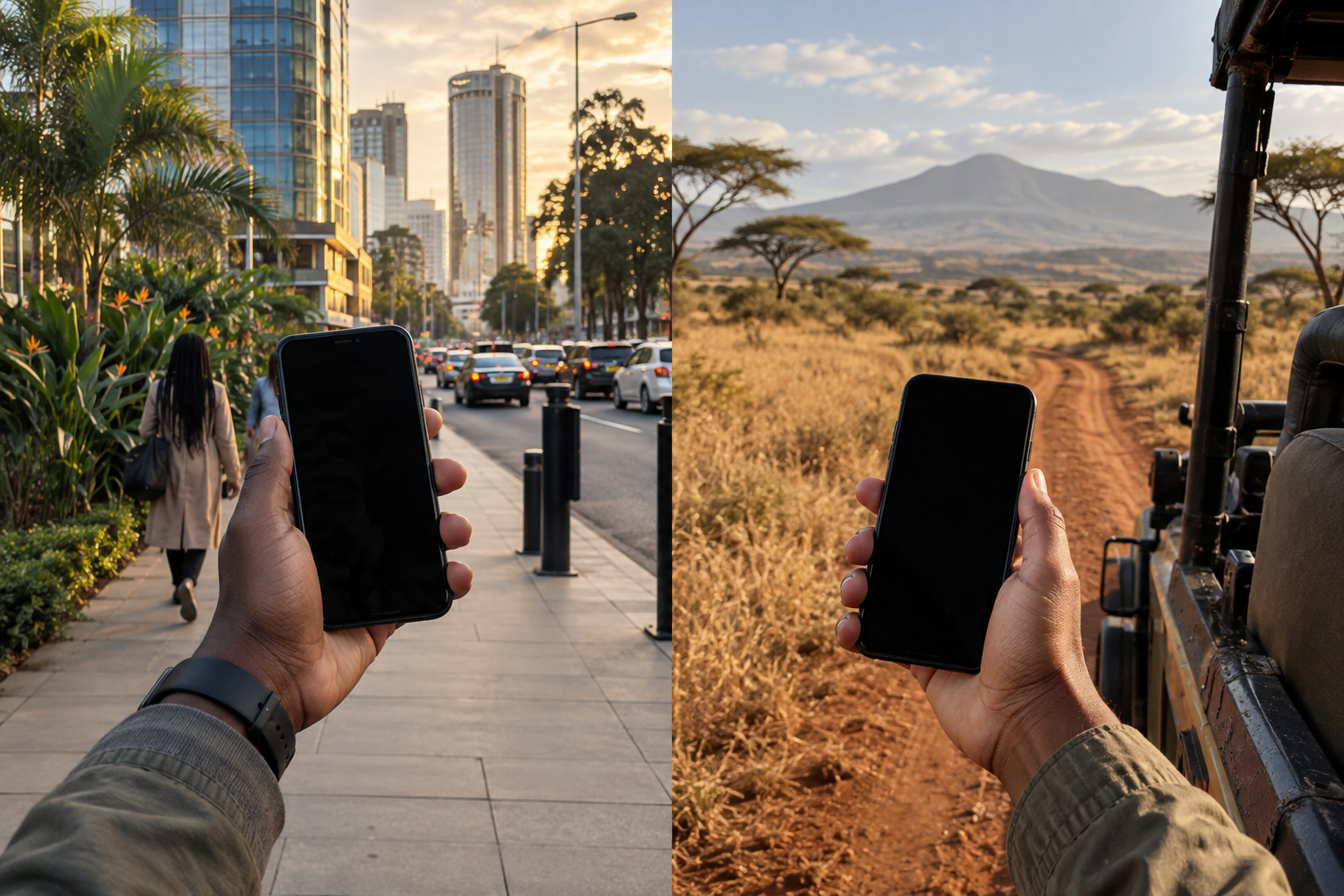
Network choice matters most when traveling beyond Kenya’s major urban centres.
Destination | Safaricom | Airtel |
|---|---|---|
Maasai Mara National Reserve | Strong coverage at major lodges, conservancies, and popular game drive routes | Minimal to nonexistent coverage in the reserve interior |
Amboseli National Park | Reliable coverage in the central lodge zone and along primary game viewing circuits | Unreliable and inconsistent coverage, including at main accommodation areas |
Nairobi CBD | Comparable 4G performance | Comparable 4G performance |
Mombasa and Diani Beach | Strong coverage in major tourist zones and stronger signals at some remote coastal points | Strong coverage in major tourist zones |
Jomo Kenyatta International Airport | Connectivity activates immediately for compatible eSIM profiles | Connectivity activates immediately for compatible eSIM profiles |
For related planning information, see this Kenya eSIM guide. You can also check the official Safaricom website and Airtel Kenya website before choosing a network.
Frequently Asked Questions
Is Safaricom better than Airtel in the Maasai Mara?
Safaricom provides stronger coverage across the Maasai Mara, including major lodge concentrations, conservancy areas, and popular game drive routes. Airtel coverage is minimal to nonexistent in the reserve interior.
Which network is better in Nairobi in 2026?
Both Safaricom and Airtel deliver comparable 4G performance and connection reliability in Nairobi's Central Business District and surrounding metropolitan neighborhoods.
Do Safaricom and Airtel work at Jomo Kenyatta International Airport?
Both networks activate immediately upon arrival when travelers have compatible eSIM profiles installed on their devices before departure.
Which network should travelers choose for the Kenyan coast?
Both carriers provide strong infrastructure in major Mombasa and Diani Beach tourist zones. Safaricom offers stronger signal strength at some more remote coastal points, fishing villages, and marine park access areas.
Which International eSIM Providers Use Safaricom vs Airtel Networks in Kenya?
Understanding which international eSIM providers connect through Safaricom versus Airtel infrastructure helps travelers make informed decisions based on their specific Kenya itinerary requirements. Safaricom-based eSIM providers delivering coverage across urban and safari destinations include Safari eSIM (specifically designed for Kenya safari travelers), Airalo when selecting their Safaricom-powered Kenya plan option, Nomad eSIM, GigSky, Ubigi, Yesim, and Truphone, all routing data traffic through Safaricom's extensive network infrastructure and benefiting from its superior rural and national park coverage. Airtel Kenya-based eSIM services include Holafly and aloSIM, both offering competitive pricing for urban-focused travel but inheriting Airtel's limited rural and safari zone coverage limitations. Multi-network eSIM providers whose Kenya connectivity varies depending on dynamic network selection algorithms include Maya Mobile, SimOptions, and eSIM2Fly, which may connect through either Safaricom or Airtel infrastructure based on location, network availability, and real-time roaming agreements. Travelers should verify which specific network their chosen eSIM provider utilizes in Kenya before purchase, particularly when safari destinations appear on their itinerary where network selection directly determines whether connectivity will be available at lodges and game viewing areas.
The Definitive Verdict for Tourists: Safaricom vs Airtel Kenya 2026
After comprehensive evaluation of coverage patterns, network performance, and real-world connectivity experiences across diverse Kenyan destinations in 2026, the recommendation for most international tourists becomes clear and straightforward. If your Kenya travel itinerary includes any time spent in national parks, wildlife reserves, safari lodges, conservancy areas, or rural regions beyond major cities, choosing a Safaricom-based eSIM provider represents the only practical decision for maintaining reliable connectivity throughout your journey. The coverage differential between Safaricom and Airtel in safari areas is not marginal or negligible—it fundamentally represents the difference between having usable mobile signal at your wilderness lodge, being able to share wildlife photos with family, accessing navigation for self-drive safaris, and maintaining contact with tour operators versus experiencing complete communication blackout for days at remote properties. For travelers planning pure urban itineraries focused exclusively on Nairobi business meetings, Mombasa beach resort stays, or city-based cultural tourism without any safari components or rural excursions, either network performs adequately and Airtel-based eSIM providers sometimes offer more competitive pricing for data packages. However, given that most international visitors to Kenya include at least one safari experience or national park visit in their itinerary, Safaricom's superior nationwide coverage makes it the default recommended network choice for 2026 Kenya travel.
Network Data Performance Analysis and Customer Perspectives in 2026
From a customer experience perspective, data network performance characteristics differ significantly between Safaricom and Airtel Kenya in 2026, reflecting their divergent infrastructure investment strategies and market positioning approaches. Safaricom's data network benefits from sustained infrastructure investment spanning nearly two decades, capital expenditure prioritizing tower expansion in underserved areas, and the advantages of maintaining Kenya's largest subscriber base, which generates revenue supporting continuous network growth, technology upgrades, and coverage expansion into previously unconnected regions. Airtel Kenya's data services have demonstrated substantial improvement in recent years, particularly throughout urban centers where the carrier competes directly with Safaricom through aggressive pricing strategies and promotional data bundle offerings aimed at price-sensitive city subscribers. Customer feedback collected across Kenya and throughout Airtel's broader African operations consistently suggests that data reliability and consistent connectivity matter more to most users than achieving peak download speeds, with travelers prioritizing dependable signal availability over maximum bandwidth performance. Both carriers offer comprehensive prepaid data bundle options with varying validity periods, data allowances, and pricing tiers, but Safaricom's significantly wider geographic coverage footprint means its data services remain accessible and functional across substantially more locations throughout Kenya's diverse terrain. The customer experience delivered by each network platform reflects their fundamentally different strategic priorities: Safaricom prioritizes nationwide reach, rural penetration, and universal service objectives, while Airtel focuses on delivering urban value propositions, competitive city pricing, and cost-effective data packages for metropolitan subscribers. For international travelers evaluating these options, the consensus view from both customers and independent telecommunications industry observers remains unambiguous in 2026: reliable data connectivity in Kenya's safari areas, national parks, and remote destinations requires Safaricom's comprehensive infrastructure network.
Kenya eSIM from $4.99 — Safari eSIM
Unlimited data on Safaricom. Built for safari travelers.
Get Safari eSIM